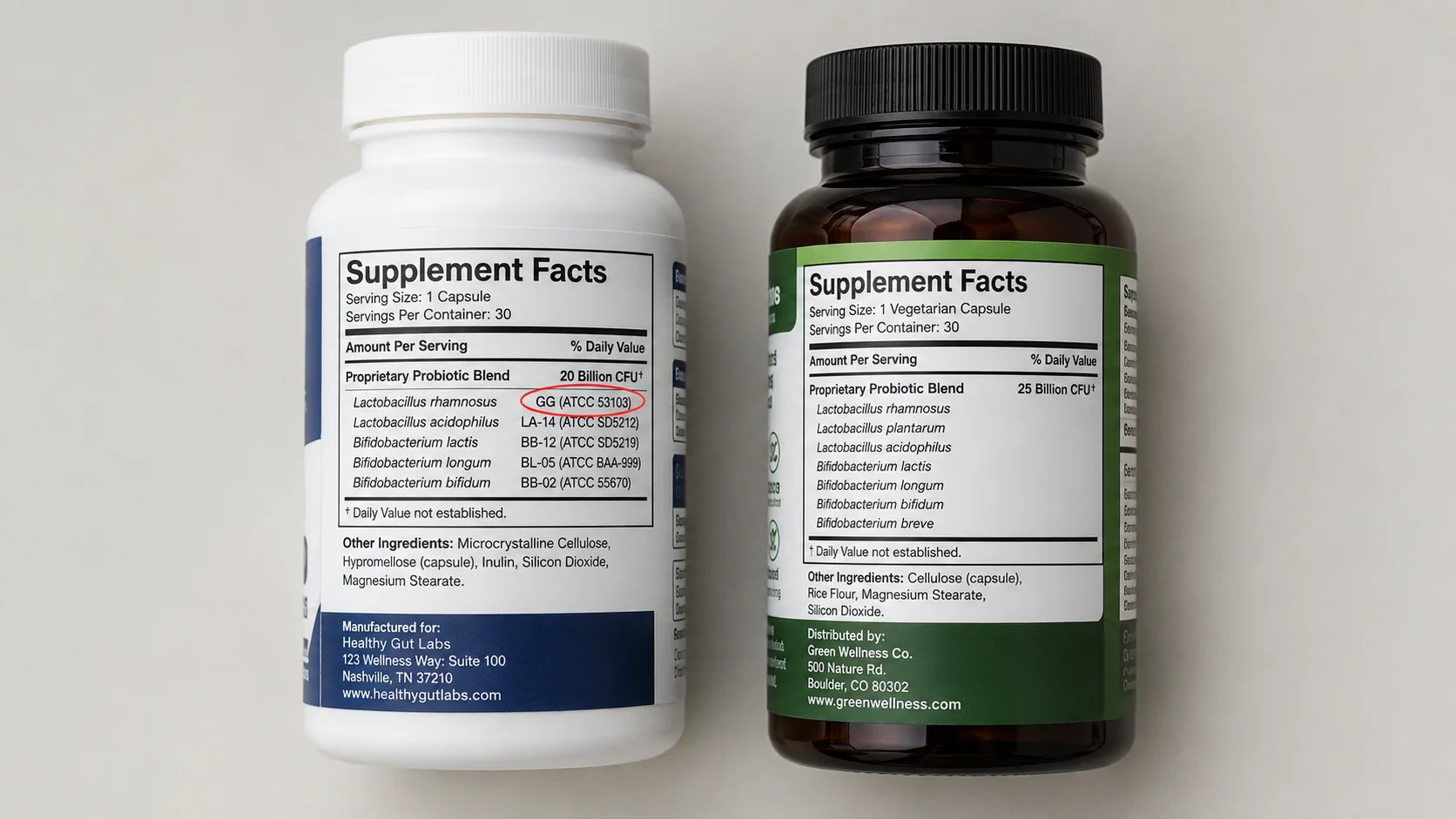
Two bottles sit side by side on the pharmacy shelf, both printed with the words Lactobacillus casei, both priced within a dollar of each other. In a 2018 systematic review of probiotic trials, one L. casei strain reduced the incidence of antibiotic-associated diarrhea to 6.7 percent, while a different strain of that same species left the rate at 33.3 percent, a difference the authors reported as statistically significant. Same genus on the label, same species on the label, five times the difference in what happened to the people who took it.
What separates those two products is the strain designation, the short alphanumeric tag that follows the species name and points to one specific organism deposited in a culture collection. On the better bottle it reads DN-114001. On a great many bottles it does not appear at all, and the federal regulation that governs supplement labels does not require anyone to print it.
So the practical answer for anyone standing in that aisle is narrower than the marketing suggests. A probiotic is worth buying when the label names the genus, the species and the strain, when that exact strain has been tested in people for the thing you want it to do, and when the dose on the panel matches the dose in the trial. Everything else on the front of the box, the strain count, the billions, the words "advanced" and "clinically studied," moves independently of whether the product will work.
The strain is the unit of evidence
The 2014 consensus statement from the International Scientific Association for Probiotics and Prebiotics, published in Nature Reviews Gastroenterology and Hepatology, defines probiotics as "live microorganisms that, when administered in adequate amounts, confer a health benefit on the host". Read that definition slowly and the burden it places on a label becomes obvious, because "adequate amounts" of which organism, conferring which benefit, are questions a genus name cannot answer.
Researchers have tested the question directly. A 2018 meta-analysis in Frontiers in Medicine examined whether probiotic effects travel across strains and concluded that "the efficacy of probiotics is both strain-specific and disease-specific", and that the L. casei comparison above was one of its clearest illustrations. A companion evidence guide published in PLOS ONE in December 2018 went further and mapped individual strains to individual conditions, where the pattern gets stranger still.
Lacticaseibacillus rhamnosus GG, the most studied probiotic in the world, was found effective for treating acute pediatric diarrhea across ten trials, and in the same guide it was described as ineffective for preventing it. One organism, one illness, two directions depending on whether the child is already sick. Saccharomyces boulardii CNCM I-745, a yeast rather than a bacterium, carried strong evidence for preventing antibiotic-associated diarrhea and shortened the duration of acute diarrhea by 19.7 hours across seventeen trials. A separate individual-participant meta-analysis published in Pediatrics in January 2018 found that Limosilactobacillus reuteri DSM 17938 reduced crying time in colicky infants who were breastfed, while the same strain at the same dose did not reach significance in formula-fed infants.
That last finding is the one worth sitting with. Even when the strain is right, the population it was tested in is part of the claim, which is why the useful question in the aisle is never "is this a good probiotic" but "was this organism tested in someone like me, for this."
The names on the old bottles stopped being true in 2020
In April 2020, a taxonomy paper in the International Journal of Systematic and Evolutionary Microbiology split the genus Lactobacillus into twenty-five genera, twenty-three of them newly created, after genomic analysis showed the old grouping held organisms too genetically distant to share a name. Lactobacillus rhamnosus became Lacticaseibacillus rhamnosus. Lactobacillus plantarum became Lactiplantibacillus plantarum. Lactobacillus reuteri became Limosilactobacillus reuteri. A handful of familiar species, including L. acidophilus, kept the original genus name.
ISAPP's explainer on the change makes the point that matters to a shopper in one sentence: "Species names and strain designations have not changed." The genus, in other words, was unstable enough to be rewritten wholesale by a committee of microbiologists, while GG stayed GG and DN-114001 stayed DN-114001. The part of the label that scientists trusted enough to leave alone is the part most products omit.
What is actually printed on American shelves
In 2019, a team led by Daniel Merenstein at Georgetown University walked into four large national retailers in the Washington, D.C. area and read the labels of 93 probiotic products, 67 of which were unique. To count as supported by evidence, a product had to clear three bars at once: disclose its strain designation, deliver that strain at a dose shown to work, and have at least one controlled human trial published. Thirty-three products, or 35 percent, cleared all three.
"The higher number of strains, higher dose or greater cost were not associated with evidence."
That is Merenstein, quoted in the Georgetown University Medical Center release announcing the study, and it inverts the way probiotics are merchandised. The paper found that a product with fewer strains was more likely to be supported by the evidence, and that the expensive multi-species formulations stacked at eye level were frequently the ones with nothing behind them. His advice to shoppers in the same release was blunt: "Consumers will have to do legwork themselves to figure out the best product to buy."
Two things about that 35 percent figure deserve care, because the number has been loosely repeated. It is a composite failure rate, so a product could print a perfectly good strain code and still fall short on dose or on published evidence. And it says nothing about whether the bacteria in the bottle match the label, which is a separate question with a more reassuring answer. A 2020 analysis in Frontiers in Microbiology tested 182 probiotic supplements sold in the United States and Canada using targeted and non-targeted PCR and found 15 of 182 products, or 8 percent, out of compliance, with 93 percent of the samples meeting or exceeding their declared viable count. The organisms in the capsule are usually the species the box claims. The gap is in the information, not the contents, which is exactly why the missing strain code is the problem worth solving.
The rule that lets it happen
Supplement labeling in the United States runs through 21 CFR 101.36, which requires dietary ingredients to be declared by their "common or usual name." The regulation gets specific about botanicals, instructing that the listing "shall specify the part of the plant from which the ingredient is derived", so a bottle cannot simply say valerian without saying root. No parallel instruction exists for microorganisms. The rule does not require a genus, a species, a subspecies or a strain, which is how a panel can read "proprietary probiotic blend" and remain fully compliant.
The one probiotic-specific labeling action FDA has taken concerns quantity rather than identity. In September 2018 the agency issued draft guidance saying it intends to exercise enforcement discretion for firms that declare live microbial content in colony forming units in addition to the weight declaration the regulation requires. CFU labeling is therefore permitted rather than mandated, and it rests on non-binding draft guidance. Weight, as the agency's own document acknowledges by allowing the CFU alternative, is a poor proxy for how many organisms are alive when the capsule reaches you, a mismatch between what a panel measures and what a buyer needs that runs through the supplement aisle generally, as the recent potency testing on gummy vitamins made plain.
How to read the panel in about ninety seconds
Start at the ingredient line and look for three parts in sequence, because ISAPP, following the FAO and WHO guidelines, says a label should carry the "genus, species and strain designation for each probiotic strain in the product" along with the minimum viable count of each strain at the end of shelf life. A product that gives you all of that is telling you it expects to be checked. A product that gives you a genus and a total CFU count across an unnamed blend has decided you will not look.
The second check is the dose. Find the CFU figure attached to the specific strain rather than to the blend, then confirm it is guaranteed through the expiration date rather than at time of manufacture, a distinction Merenstein's team tracked separately because only 18 of the 33 evidence-supported products made the stronger promise. Effective doses in the antibiotic-associated diarrhea trials ran from ten million to ten billion organisms daily, started within a day or two of the antibiotic and continued for one to four weeks, which means a product can carry the right strain and still be dosed too low to reproduce the result.
The third check is the match between the strain and your reason for buying. ISAPP's own analysis of label disclosure found that "if your food product discloses the strain designation, it is likely to have evidence of a health benefit", which is a useful shortcut precisely because printing the code is a costly signal for a company with nothing to point to. Search the strain code, not the brand, and see whether the trial population resembles you.
None of this makes a probiotic the first move. Most of the microbial benefit available to an ordinary person still comes from what reaches the colon in food, which is the argument for closing the fiber gap before shopping the refrigerated case. But when there is a specific job, a course of antibiotics starting Monday, a child with acute diarrhea, a recurrence someone is trying to prevent, the job has a strain attached to it, and the strain has a number. Bring the number to the shelf and most of the aisle disqualifies itself.