For years, protein has enjoyed the nutritional equivalent of celebrity status. It has been added to cereal, coffee, snack bars, pasta, cookies, water, and products that were doing perfectly well without a protein makeover. Walk through almost any grocery store and the message is difficult to miss: more protein must mean better health.
But another nutrient is beginning to move from the supporting cast to center stage. Dietary fiber, once discussed mainly in conversations about regularity, is being reconsidered as an essential part of digestive, metabolic, cardiovascular, and whole-body wellness.
The renewed interest is not entirely surprising. Gut health has become a major wellness priority, and consumers are learning that digestion involves much more than avoiding occasional discomfort. The digestive system interacts with metabolism, immune function, blood sugar regulation, appetite, and the enormous community of microorganisms living in the intestinal tract.
Fiber participates in many of those processes. It also comes packaged naturally in foods that provide vitamins, minerals, antioxidants, plant compounds, and other nutrients. That makes the growing fiber conversation more meaningful than another passing supermarket trend, provided we do not turn it into an extreme competition.
Why fiber is finally getting its moment
Protein remains important. The body needs it to build and repair tissue, produce enzymes and hormones, and preserve muscle. The problem is not protein itself. The problem is the assumption that maximizing one nutrient automatically produces better health.
A person can consume large amounts of protein while eating very few vegetables, beans, fruits, or whole grains. A meal can display an impressive protein number on the label while still offering little fiber or plant variety. This is one reason the fiber conversation matters: it encourages people to evaluate the overall quality of a meal rather than worship a single number.
Fiber has also benefited from the public's growing interest in gut health. Certain fibers travel through the upper digestive tract without being fully broken down. When they reach the colon, intestinal microorganisms can ferment some of them and produce compounds that help support the environment of the gut.
This does not mean that every fiber product will transform the microbiome or that every digestive symptom can be solved by eating more roughage. It means that fiber-rich plant foods are a foundational part of a varied eating pattern and deserve considerably more attention than they have historically received.
What dietary fiber actually is
Fiber is a form of carbohydrate found primarily in plant foods. Unlike sugars and starches, much of it is not fully digested and absorbed in the small intestine. Different fibers behave differently in the body, which is why the word fiber describes a broad family rather than one identical substance.
Soluble fiber dissolves or thickens in water. It is found in foods such as oats, barley, beans, lentils, apples, citrus fruit, chia seeds, and psyllium. Certain soluble fibers can help slow digestion, contribute to fullness, and support healthy cholesterol levels.
Insoluble fiber does not dissolve in water in the same way. It adds bulk to stool and helps food move through the digestive system. Sources include wheat bran, many vegetables, whole grains, nuts, seeds, and the skins of certain fruits.
Many plant foods contain a mixture of both types. There is usually no need for a healthy person to calculate soluble and insoluble fiber separately at every meal. Eating a diverse selection of minimally processed plant foods is a more practical strategy.
Fiber does more than support regularity
Digestive regularity remains one of fiber's best-known roles. Fiber can add bulk, retain water, and support stool movement, although the effect depends on the type of fiber, hydration, physical activity, and the individual's digestive condition.
Its potential benefits extend further. Fiber-rich meals often take longer to eat and digest than highly refined foods. This can support healthy satiety, helping a meal feel more substantial without relying on oversized portions or rigid restriction.
Soluble and viscous fibers may also slow the absorption of carbohydrates. When consumed as part of balanced meals, high-fiber foods may help produce a steadier blood sugar response than heavily refined foods with little fiber. That does not make fiber a substitute for diabetes treatment, but it helps explain why beans, whole grains, vegetables, and intact fruit are repeatedly included in evidence-based eating patterns.
Fiber also contributes to cardiovascular nutrition. According to the American Heart Association, dietary fiber from whole grains and other plant foods can support healthier blood cholesterol and is associated with a lower risk of several chronic conditions. The strongest benefits tend to appear within an overall eating pattern, not from sprinkling a token amount of fiber powder onto an otherwise unbalanced diet.
The connection between fiber and the gut microbiome
The human digestive tract contains a vast collection of microorganisms often described as the gut microbiome. These organisms interact with food components, including fibers that human digestive enzymes cannot completely break down.
Some fibers function as prebiotics, meaning they are used by beneficial microorganisms in ways that may support the intestinal environment. Fermentation can produce short-chain fatty acids, compounds that are being studied for their roles in colon health, metabolism, and immune signaling.
However, microbiome science is complex. Different people can respond differently to the same food, and commercial claims often move faster than the evidence. A cereal, soda, snack, or gummy containing added fiber should not automatically be treated as equivalent to a varied diet rich in vegetables, beans, fruits, nuts, seeds, and whole grains.
Whole foods deliver what might be called a nutritional neighborhood. Fiber arrives alongside multiple nutrients and plant compounds that may work together. An isolated ingredient can be useful, but it does not always recreate that complete environment.
How much fiber do adults need?
Fiber recommendations vary by age, sex, calorie needs, and life stage. A commonly used benchmark is approximately 14 grams of fiber for every 1,000 calories consumed. For many adults, that translates to a daily target somewhere between roughly 22 and 38 grams.
Those numbers are general planning tools, not instructions to force-feed yourself bran until a nutrition app celebrates. Someone who currently eats very little fiber should not leap to the highest target overnight.
The better question is whether your usual meals regularly include high-fiber foods. Is there a vegetable or fruit at most meals? Do beans or lentils appear during the week? Are some refined grains replaced by oats, barley, brown rice, quinoa, whole-wheat bread, or other whole grains? Do nuts and seeds have a place in snacks or meals when appropriate?
Those patterns reveal more about dietary quality than a single day's numerical score.
Why suddenly eating more fiber can backfire
Once people discover that fiber is important, some try to correct years of low intake in a weekend. This has helped inspire the social-media idea sometimes called fiber-maxxing: deliberately pushing fiber intake as high as possible.
The enthusiasm is understandable. The method can be uncomfortable.
A rapid increase may lead to gas, bloating, abdominal pressure, cramping, or changes in bowel movements. The National Institute of Diabetes and Digestive and Kidney Diseases recommends increasing fiber gradually, particularly for people who are sensitive to digestive changes. For some individuals with irritable bowel syndrome, adding approximately two to three grams per day may be easier to tolerate than making a dramatic jump.
Increasing fiber gradually gives the digestive system and intestinal microbes time to adjust. It also makes it easier to identify foods that cause symptoms rather than introducing five new powders, cereals, legumes, and seeds at once.
Hydration matters as well. Fiber interacts with water in the digestive tract. Increasing fiber without drinking enough fluid may worsen constipation or discomfort for some people. Water needs vary, but urine color, thirst, activity level, weather, medications, and medical conditions can help guide individual hydration decisions.
A whole-food approach to getting more fiber
The simplest strategy is not to redesign every meal. Add one meaningful source of fiber to foods you already eat.
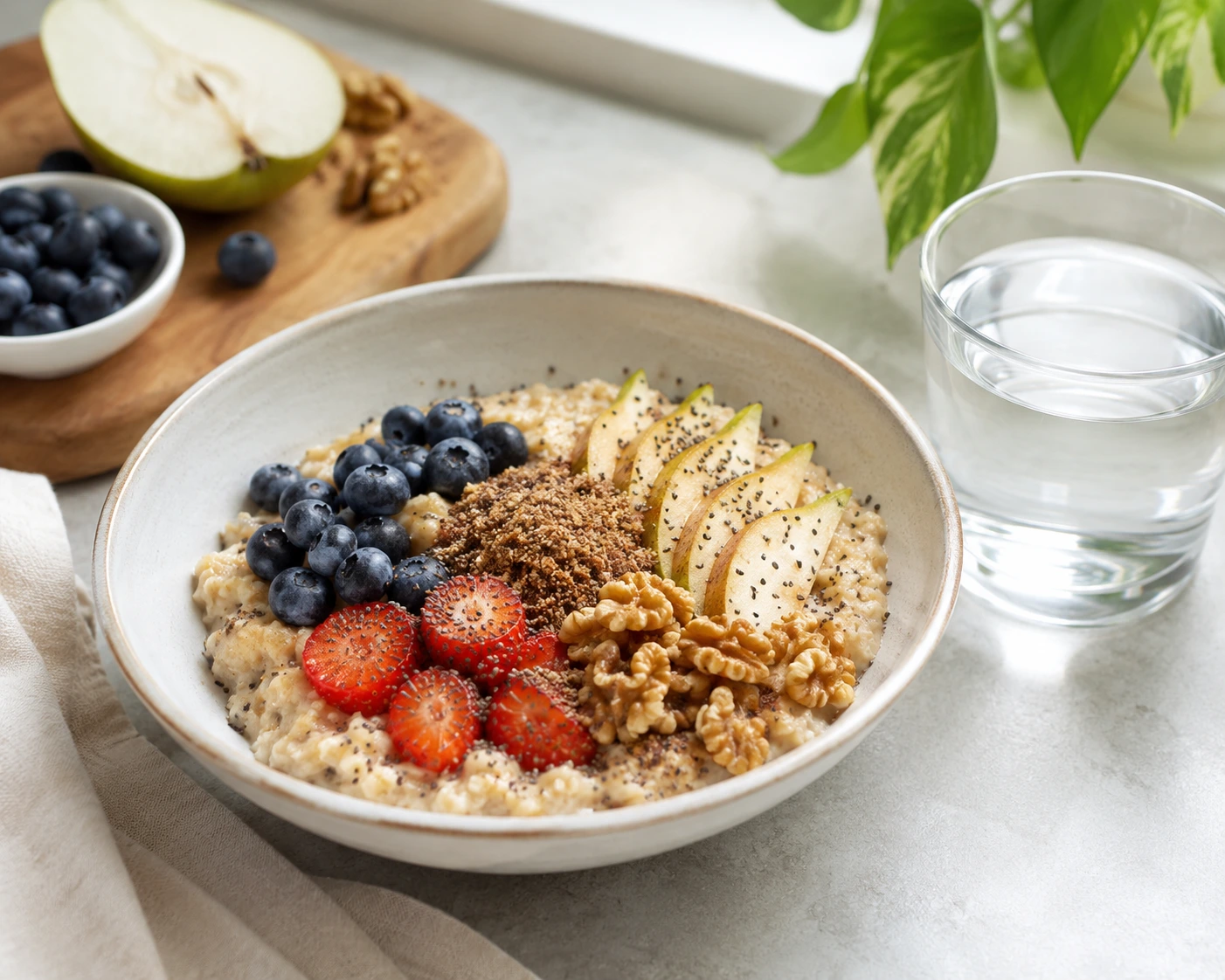
Breakfast might include oatmeal topped with berries and ground flaxseed. Yogurt can be paired with chia seeds, fruit, and a modest amount of nuts. Eggs can be served with vegetables and whole-grain toast instead of being treated as a protein-only event.
Lunch can include lentil soup, a bean-based salad, a whole-grain wrap filled with vegetables, or leftovers served over brown rice or quinoa. Dinner might include roasted vegetables, beans, peas, barley, sweet potatoes with the skin, or a side salad containing several plant ingredients.
Snacks can also contribute. Pears, apples, berries, carrots, air-popped popcorn, nuts, roasted chickpeas, and hummus can provide more fiber than many highly processed snack products.
Beans and lentils deserve special recognition because they combine plant-based fiber, protein, minerals, and affordability. Canned versions can reduce preparation time. Rinsing canned beans may reduce some of the sodium, while starting with smaller portions may make them easier to tolerate.
Flax, chia, and psyllium are useful, but they are not interchangeable
Seeds and supplemental fibers can help close dietary gaps, but each has different characteristics.
Ground flaxseed provides fiber and alpha-linolenic acid, a plant-based omega-3 fatty acid. Grinding flax makes its nutrients more accessible than swallowing the seeds whole. It can be added to oatmeal, smoothies, yogurt, baked foods, and pancake batter.
Chia seeds absorb liquid and form a gel-like texture. They provide fiber and can be used in oatmeal, yogurt, smoothies, or chia pudding. Because they expand when exposed to fluid, they should be consumed with appropriate liquid and not swallowed dry by the spoonful.
Psyllium is a concentrated soluble fiber commonly used in supplements. It may support regularity and healthy cholesterol levels for some people. It should be taken according to product directions with sufficient fluid. It may also affect the absorption or timing of certain medications, making professional guidance important for people managing prescriptions or chronic conditions.
No seed or powder should become the entire fiber plan. Whole-food fiber sources provide greater dietary variety and usually offer more complementary nutrients.
How to evaluate fiber-enhanced products
As fiber becomes fashionable, manufacturers are adding it to bars, drinks, cereals, cookies, powders, and snack foods. Some of these products are useful. Others are ordinary processed foods wearing a digestive-health costume.
Begin with the full nutrition label. Look at the serving size, total fiber, added sugar, sodium, saturated fat, and ingredient list. A product containing fiber is not automatically low in sugar or nutritionally balanced.
Also notice the source. Ingredients such as inulin, chicory root fiber, resistant starch, polydextrose, and soluble corn fiber are commonly added to foods. They can increase fiber content, but large amounts may cause gas or bloating in sensitive people.
The best product is not necessarily the one advertising the highest number. It is the one that fits your nutritional needs, digestive tolerance, budget, and usual eating pattern.
Who should be cautious about increasing fiber?
More fiber is not appropriate in every circumstance. People with certain bowel obstructions, active inflammatory digestive conditions, swallowing disorders, severe gastroparesis, recent gastrointestinal surgery, or medically prescribed low-fiber diets may need individualized instructions.
Persistent constipation, blood in the stool, unexplained weight loss, severe abdominal pain, vomiting, or a sudden change in bowel habits should not be self-treated indefinitely with fiber supplements. These symptoms warrant medical evaluation.
People taking medications should ask a pharmacist or qualified healthcare professional whether a concentrated fiber supplement needs to be separated from their medication. Pregnant individuals and people managing diabetes, kidney disease, or gastrointestinal disorders may also benefit from personalized guidance.
A better wellness goal than fiber-maxxing
The healthiest lesson from the fiber trend is not that everyone should consume the largest possible amount. It is that modern eating patterns often leave too little room for intact plant foods.
A sustainable goal is to build fiber-rich meals that are enjoyable, varied, affordable, and compatible with your digestive system. Increase portions gradually. Drink appropriate fluids. Pay attention to symptoms. Favor food diversity over supplement stacking.
Protein does not need to surrender its place at the table. It simply needs company. A balanced plate can include protein alongside beans, vegetables, whole grains, fruit, nuts, or seeds. That combination is less glamorous than a neon wellness powder, but it is more likely to support health after the trend cycle moves on.
Fiber may be having its cultural moment in 2026. The foods supplying it, however, have been quietly doing valuable work for generations.
This article is for general educational purposes and is not a substitute for individualized medical or nutritional advice.