In Qidong, a city in China's Jiangsu province, fifty adults agreed in 2011 to drink a broccoli beverage every night for a week, pause, and then switch to a different one. Forty-eight of them finished the trial. Their median age was forty-six, two thirds were women, and the two drinks they alternated between were built from the same vegetable, prepared two different ways, by researchers from Johns Hopkins University working with the Qidong Liver Cancer Institute.
One beverage carried 800 micromoles of glucoraphanin, the storage compound that broccoli actually contains. The other carried 150 micromoles of sulforaphane, which is what glucoraphanin becomes after an enzyme cuts it apart. The drink with more than five times the molar dose on paper delivered far less of it into circulation, and the published recovery figures tell the whole story: roughly seventy percent of the sulforaphane dose turned up in urine, against about five percent from the glucoraphanin version.
The difference was not the vegetable, the purity, or the dose. It was an enzyme called myrosinase, which broccoli keeps in separate cellular compartments from glucoraphanin and releases only when the plant tissue is damaged. Strip the enzyme out, and the compound on the label stops being the compound in the body.
What myrosinase actually does
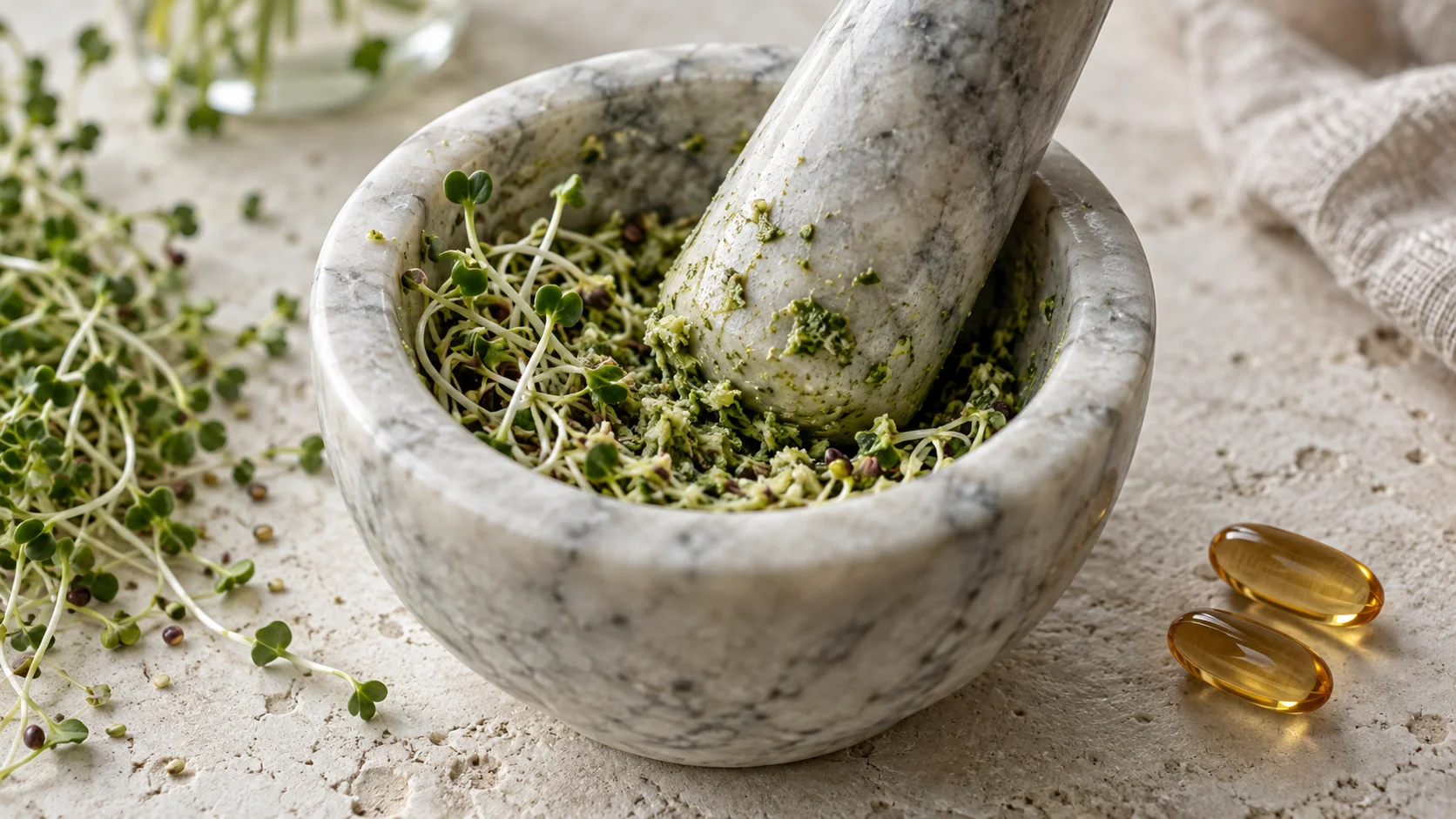
Broccoli stores glucoraphanin as inert cargo. Chewing, chopping, crushing or freeze-drying ruptures the cell walls and lets myrosinase reach the glucoraphanin, at which point the enzyme hydrolyses it into sulforaphane, the isothiocyanate that the research literature actually studies. Heat denatures myrosinase, and most manufacturing processes that concentrate broccoli seed or sprout material into a capsule apply heat somewhere along the line.
The Qidong trial handled this by pre-converting one beverage with daikon radish enzyme before anyone drank it, which is why that arm behaved so differently. Its authors closed by recommending that future work use blends rather than either compound alone, writing that optimal dosing "should consider blends of sulforaphane and glucoraphanin" in order to hit peak concentrations quickly while sustaining exposure over a longer window.
Three studies, one repeated number
Four years after Qidong, a Johns Hopkins group led by Jed Fahey published a crossover study in PLOS ONE that tested the question across delivery formats rather than across one pair of drinks. Preparations rich in glucoraphanin but lacking the enzyme returned a mean recovery near ten percent of dose, showing up as 9.4 percent, 10.3 percent and 10.4 percent in different formats. Freeze-dried broccoli sprouts with the enzyme intact returned 40.8 percent, and broccoli seed powder returned 36.1 percent.
The researchers also ran one commercial gel-cap product then on the market through the same protocol. It contained no active enzyme, and it delivered the same ten percent as everything else in that group. Their conclusion was written without hedging: "whereas matrix effects were minimal, the presence of active myrosinase led to substantial and significant enhancement of sulforaphane bioavailability." Formulation, flavor masking and capsule design moved the number very little. The enzyme moved it three to four fold.
The most recent replication arrived in Scientific Reports on February 15, 2026, when a team led by Angela Mastaloudis ran a randomized, double-blind crossover trial in sixteen healthy volunteers between the ages of twenty-five and sixty-five. Glucoraphanin from broccoli seed extract alone reached 18.6 percent bioavailability. The same extract paired with myrosinase sourced from mustard seed reached 39.8 percent. In the first eight hours, the window that matters for anyone dosing once a day, conversion ran 8.0 percent without the enzyme and 25.4 percent with it, a 3.2 fold difference. The authors summarized it in seven words: the combination "doubled the bioavailability of SF."
Your gut bacteria are the backup, and they are inconsistent
The ten to eighteen percent that still converts without any added enzyme does not come from nowhere. Gut bacteria carry their own thioglucosidase activity and perform some of the same reaction in the colon, several hours downstream of where plant myrosinase would have done it in the small intestine. That backup exists in everyone, but it does not work equally well in everyone.
The 2026 trial published individual ranges alongside its averages, and the spread is the part worth reading twice. Without the enzyme, participants landed anywhere from 2.2 percent to 38.1 percent. With it, the range ran from 5.3 percent to 76.9 percent. Two people taking the identical capsule at the identical dose can absorb an order of magnitude differently from each other, which is why single-subject reports about how a supplement made someone feel carry so little information.
What these trials did not measure
Every figure above describes absorption and nothing else. The Qidong study enrolled fifty people and completed forty-eight, the 2015 crossover ran five subjects through most of its sub-studies with seventeen more recruited for the commercial comparison, and the 2026 replication used sixteen. None of them was designed to test whether sulforaphane changes a health outcome, and none of them should be read as though it were.
What the three do establish, across fifteen years, three research groups and three delivery formats, is that the pharmacokinetics of this compound are governed by one enzymatic step rather than by dose. That matters most to anyone trying to reproduce a published protocol at home, because a product that delivers ten percent of its stated dose is not a lower dose of the same thing tested in the literature. It is a different exposure curve, arriving later, by a different route, with a spread between users wide enough to swallow most of the effect a study was looking for.
What this changes at the shelf
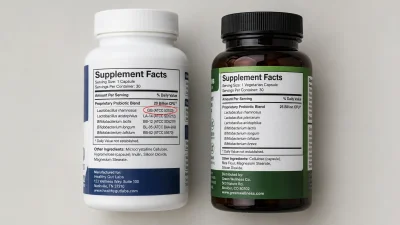
A milligram figure for glucoraphanin describes what went into the capsule, not what reaches tissue. The question that separates two products with identical front labels is whether anything in the formula performs the hydrolysis: either an added enzyme source, usually listed as myrosinase or as mustard seed extract, or a preparation that converted the compound before encapsulation and declares sulforaphane rather than its precursor.
The same logic runs through the rest of a cabinet. We have written before about how absorption depends on what a dose is taken with and when, and about the bioactives that behave differently in a bottle than they do in a plant. Sulforaphane belongs to a category where the plant's own chemistry is doing work that manufacturing can quietly remove.
There is a unit problem too. The trials report doses in micromoles, because that is how the chemistry is measured, while retail labels almost always report milligrams, which makes direct comparison against a published protocol harder than it looks. The 800 micromoles of glucoraphanin used in Qidong works out near 350 milligrams, and the 150 micromoles of sulforaphane in the comparison arm works out near 27 milligrams, so a bottle promising hundreds of milligrams of extract is not describing the same quantity as a bottle promising tens of milligrams of the converted compound.
Food does this without being asked
Raw broccoli and raw sprouts carry both halves of the reaction, which is why the freeze-dried sprout preparations in the 2015 study outperformed every heated extract tested against them. That is not an argument against supplementation so much as a description of what supplementation has to replace. When a capsule supplies active myrosinase alongside the precursor, the published bioavailability figures move into the same range as the whole food.
Fahey's group found the highest recovery of all, roughly forty percent on a molar basis, in a preparation where the conversion had already happened in the glass before anyone swallowed it. Fifteen years after Qidong, the finding has not moved: the enzyme is the variable, and the dose on the front of the bottle is not.