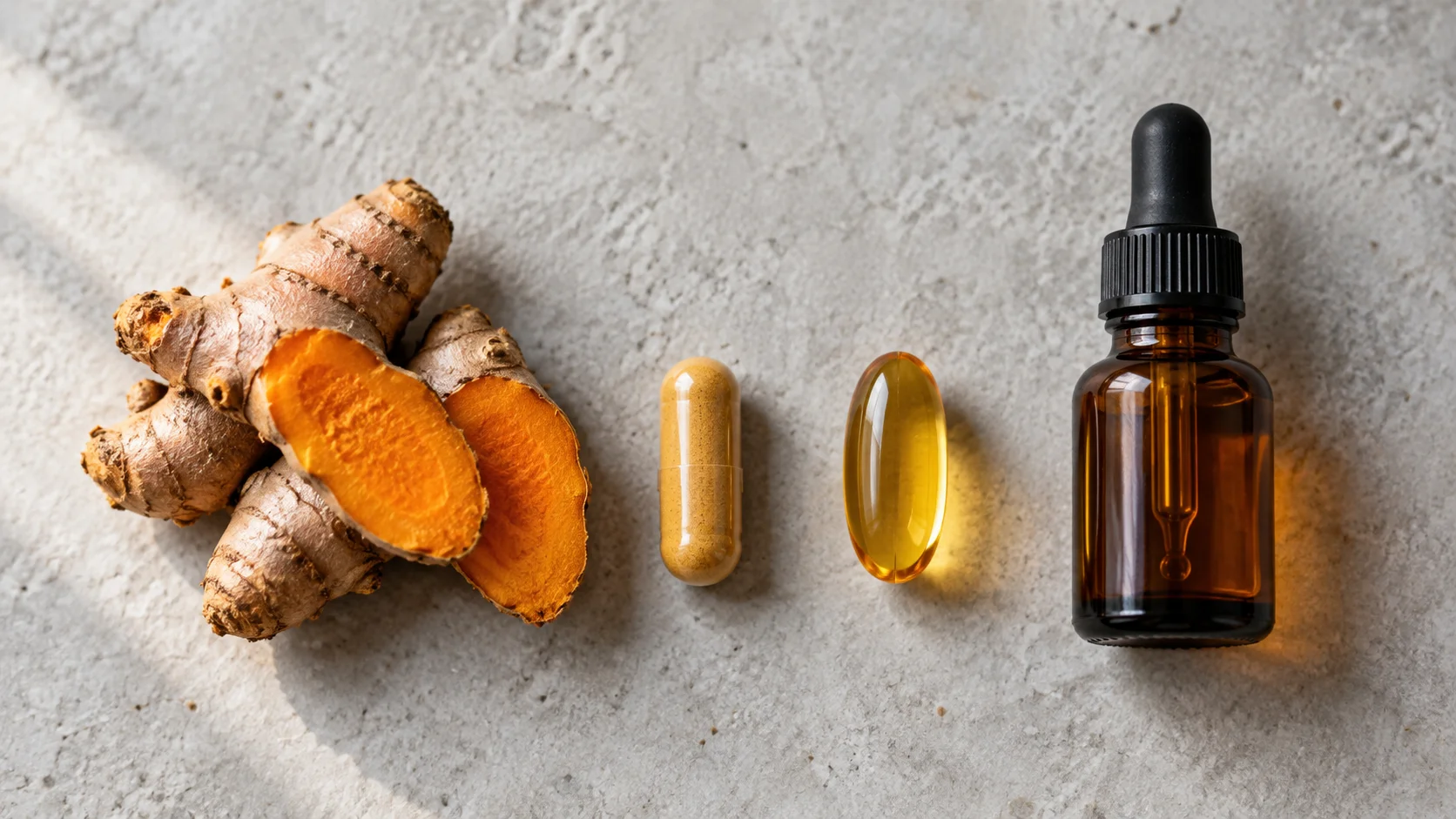
Walk the supplement aisle of almost any American pharmacy this fall and the turmeric bottles have stopped selling turmeric. The front panels sell a delivery system instead: black pepper extract, phytosome, micellar liquid, liposomal softgel, each paired with a multiplier promising how much more curcumin reaches the bloodstream than the plain root ever could. The pitch rests on a real problem, and the people who regulate supplements in Europe, Australia and Canada have spent the past four years asking what happens when the industry solves it.
The problem is chemistry: "Curcumin has very low bioavailability, i.e. it is poorly absorbed into the bloodstream and is very rapidly eliminated by the body," Fanny Huret, who coordinated the expert appraisal at the French food safety agency ANSES, said in the agency's 2022 alert on turmeric supplements. "Manufacturers have developed various formulations to increase this bioavailability and thereby enhance the effects of curcumin."
Here is the short answer for shoppers. Enhanced bioavailability turmeric does raise blood levels of curcuminoids in controlled trials, though by very different amounts depending on the formulation and on what the lab chose to measure. No trial has shown that the extra absorption translates into extra benefit, and the same concentrated and absorption-boosted products sit at the center of rare but serious liver-injury reports that have pushed France, Italy, the United Kingdom, Australia, Canada and the United States Pharmacopeia toward warnings and label language.
What the Absorption Trials Measured
The most cited head-to-head comparison is a randomized crossover trial published in 2021 in The Journal of Nutrition. Thirty healthy adults between 18 and 45 each took five products on separate occasions: a standard turmeric extract at 1,500 milligrams, a micellar liquid at 1,000 milligrams, a curcumin and piperine combination at 1,515 milligrams, a phytosome at 1,000 milligrams and a dried colloidal suspension at 300 milligrams. After the researchers normalized for dose, the colloidal form delivered roughly 24 times the relative bioavailability of the standard extract, about 22 times the piperine product and about six times the phytosome, while the micellar liquid produced the highest absolute exposure at 8,540 nanogram hours per milliliter of total curcuminoids. The corresponding author worked at Givaudan, and the colloidal ingredient is a Naturex product, so the trial belongs in the industry-affiliated column of the evidence.
An independent team at Amsterdam UMC asked a narrower question in a crossover study published in iScience in 2025, funded by an internal hospital grant. Nine healthy men took plain curcumin at 600 and 2,400 milligrams, the higher dose combined with 20 milligrams of piperine, and two branded enhanced formulations, NovaSOL and Longvida. The researchers tracked only unconjugated curcumin, the free form that laboratory experiments use, and reported that its plasma levels "remained below 2 nM in most cases, including high-dose AOV and piperine combinations." Their verdict on black pepper extract ran to five words: "Piperine addition provided no benefit."
Only NovaSOL produced measurable free curcumin, with a median peak of 14.9 nanomolar, while cell studies that report anti-inflammatory effects typically use concentrations between 1 and 100 micromolar, a range that starts nearly seventy times higher. The authors concluded that "none of the tested 'enhanced' formulations achieved plasma levels of unconjugated curcumin that even remotely approached the levels necessary to trigger a pharmacodynamic response in vitro."
The two papers are less contradictory than they look. The first trial counted total curcuminoids, most of which circulate in forms the body has already tagged for disposal, and the second counted only the free compound that the marketing implies is doing the work. A label multiplier tells a shopper which of those numbers the manufacturer preferred.
What the Evidence Says About Benefit
The National Center for Complementary and Integrative Health, the federal agency that tracks the research on botanicals, states the current position bluntly on its turmeric fact sheet: "We don't know enough to definitively conclude if turmeric or curcumin is beneficial for any health purposes." The agency describes early results for knee osteoarthritis as promising and says higher-quality studies are still needed, and it lists the pairing of curcumin with piperine as one of the established techniques for increasing absorption.
That leaves the enhanced formulations in an unusual position. Their entire value proposition is a pharmacokinetic one, more compound in the blood, and the clinical question that would make that number matter to a consumer remains open.
The Liver Signal
The clearest American data come from the Drug-Induced Liver Injury Network, which published a turmeric liver injury case series in The American Journal of Medicine. Among 345 high-confidence cases attributed to herbal and dietary supplements, ten involved turmeric, all enrolled in or after 2011 and six of them since 2017. Eight of the ten patients were women, the median age was 56, and injury appeared a median of 86 days after starting the product, with a range from 38 to 429 days. One patient died of acute liver failure, and three of the seven products the network was able to test contained piperine.
The same paper found a genetic marker that points toward individual susceptibility rather than a contaminated batch. Seventy percent of the patients carried HLA-B*35:01, an allele frequency of 0.450 against 0.056 in white Americans of European ancestry and 0.069 in Americans of African ancestry. "Most cases are self-limited, with rapid improvement in liver tests on discontinuing turmeric," the authors wrote. "Rarely, the injury can be severe and result in death."
Europe reached the same territory from the regulatory side. Italy opened an investigation in 2019 after a cluster of hepatitis cases, ruled out contaminants, and later banned antioxidant and digestive claims on turmeric products while requiring warning language from the end of 2022, according to a NutraIngredients timeline published in August 2026. ANSES reported more than 100 adverse-effect reports through its nutrivigilance system, 15 of them involving hepatitis, alongside roughly 20 hepatitis cases in Italy, and the agency advised people with bile duct disease to avoid turmeric supplements entirely. The same NutraIngredients account reports that ANSES set a maximum intake of 153 milligrams of curcumin a day and that Germany's risk assessment institute found initial indications of liver damage, especially with enhanced-bioavailability preparations.
The UK Committee on Toxicity kept its acceptable daily intake at 0 to 3 milligrams per kilogram of body weight in its second draft statement, then added a sentence that reframes the whole category: "In rare individuals, consumption of turmeric at the levels found in supplements, even at low concentrations (i.e., leading to exposures below the ADI) may pose a risk of adverse effects to the liver, due to an idiosyncratic response." The committee called the piperine absorption claim "questionable with high uncertainty" and flagged micellar, nano and micro formulations for closer assessment.
Australia's Therapeutic Goods Administration issued a warning after 18 reports of liver injury through June 2023, one of them fatal. Dr Geraldine Moses, a consultant drug information pharmacist at Mater Hospital in Brisbane, told Australian Pharmacist that once products with better bioavailability arrived, including liposomal and nanoparticle curcumin, "reports of liver toxicity started to go through the roof."
Canada followed in 2025. Health Canada's review cited 12 Canadian cases and more than 60 international reports and required cautionary labels naming the signs of liver injury, from yellowing skin or eyes to dark urine, nausea, vomiting and stomach pain, according to NutraIngredients. The industry pushed back. "Health Canada's approach stands in stark contrast and diminishes trust in a system intended to protect consumers while supporting responsible innovation," said Sonia Parmar, vice president of regulatory affairs and government relations at the Canadian Health Food Association.
In 2026 the question reached the United States through the standard-setter rather than the regulator. A review by an expert committee of the United States Pharmacopeia, published in Pharmaceutical Biology, found that liver injury "typically occurs after 1 to 4 months of use" and generally resolves when the product is stopped, and it recommended cautionary labeling reading: "Liver problems have been reported very rarely in people taking supplements containing turmeric and/or curcuminoids. Consult your health-care practitioner before using this product if you have a history of liver problems."
Reading a Turmeric Label With the Directory Lens
None of this makes turmeric in food a concern, and NCCIH describes plain oral turmeric or curcumin that has not been modified to enhance bioavailability as likely safe in recommended amounts for up to two or three months. The useful shopping skill is telling the two product types apart, which is the same habit of reading past the front panel that our guide to vetting botanicals after the tejocote adulteration cases walks through step by step.
Find the delivery system before the dose
Look for piperine or black pepper extract, BioPerine, phytosome, micellar, colloidal, liposomal or nano on the ingredient panel, since each signals a product engineered to push more curcuminoid into circulation. A milligram figure on an enhanced product is not comparable to the same figure on a standard extract, a point that echoes our reporting on how formulation decides what a broccoli supplement actually delivers.
Know who should skip enhanced forms
Moses names people with established liver disease, alcohol use disorder, a history of viral hepatitis, autoimmune liver disease or cancer that has spread to the liver as higher-risk users, and she cautions against combining turmeric with anticoagulants, antiplatelet drugs, ashwagandha or boswellia. ANSES adds bile duct disease to the avoid list and asks anyone taking anticoagulants, cancer treatment or immunosuppressants to talk with a professional first.
Watch the calendar and the warning signs
The case data cluster in the first few months of use, which makes a start date worth writing down. NCCIH lists fatigue, nausea, poor appetite, dark urine and yellowing of the skin or eyes as the signals to stop the product and call a clinician, and the Canadian label language now printed on bottles there covers the same ground.
South Korea is re-evaluating turmeric this year, and the USP label language is now available to any American manufacturer that chooses to print it. Until a trial links a higher absorption number to a better outcome for people, the multiplier on the front of the bottle measures one thing reliably, which is how much more of the compound the product puts into the body.