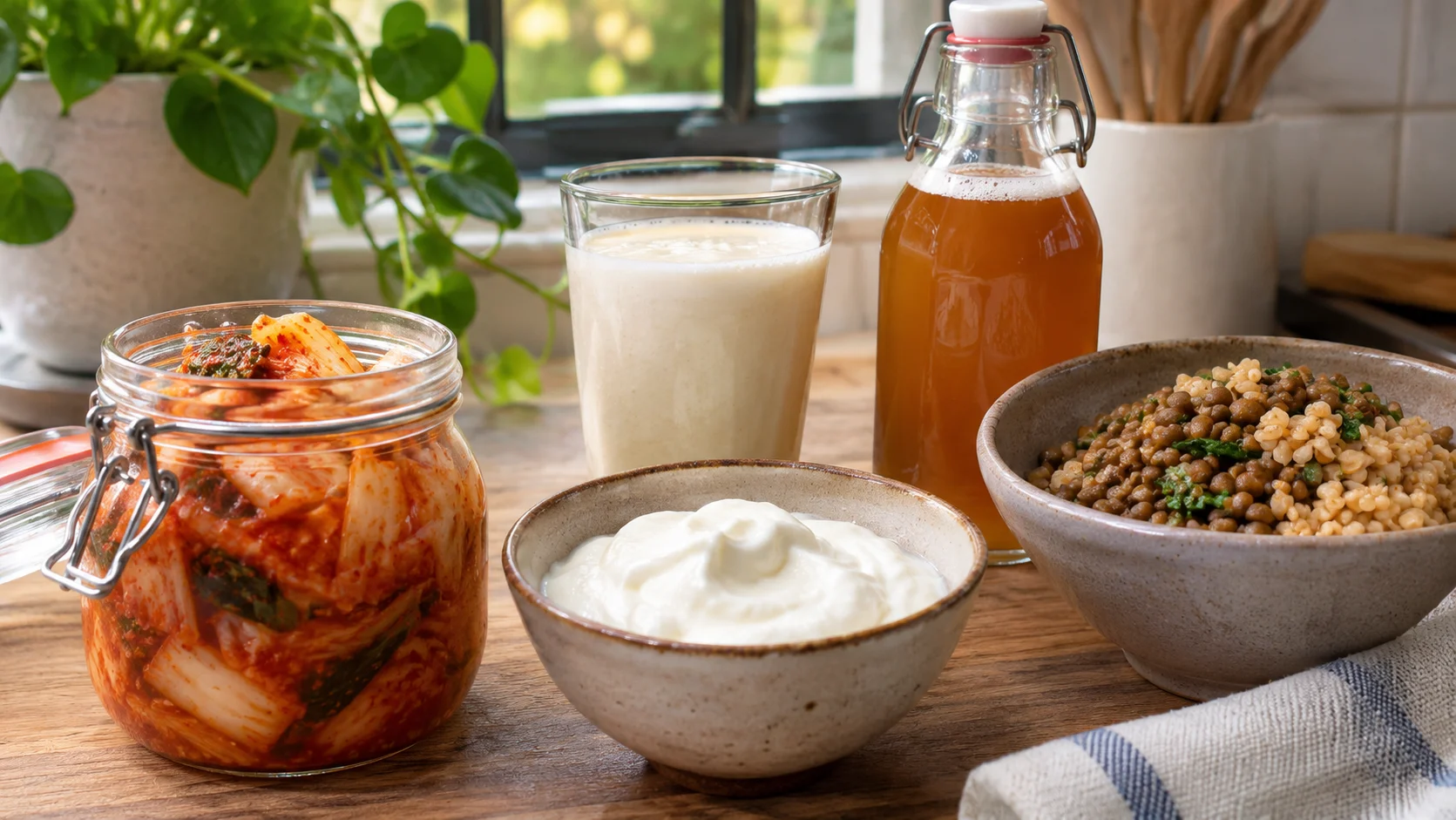
The volunteers in the Stanford trial did not take a pill. For ten weeks, half of the 36 healthy adults ate their way up to more than six servings a day of yogurt, kefir, fermented cottage cheese, kimchi, other fermented vegetables, vegetable brine drinks and kombucha. The other half loaded their plates with legumes, seeds, whole grains, nuts, vegetables and fruit.
When the samples came back, the fermented-food group showed something the fiber group did not. Their gut microbial diversity climbed steadily across the intervention, and 19 inflammatory proteins measured in their blood went down, among them interleukin 6, one of the most widely studied signals of systemic inflammation.
The direct answer for anyone weighing a change in the kitchen is that, in this trial, fermented foods raised microbiome diversity within weeks while doubling fiber did not, at least over the study window. The longer answer lives in the details, which include a primary outcome that never moved and a fiber group whose immune results split three ways.
What the Stanford Trial Measured
The study, published in Cell in July 2021 as "Gut-microbiota-targeted diets modulate human immune status", ran 17 weeks from baseline through follow-up, with 18 participants assigned to each arm. Lead authors Hannah Wastyk and Gabriela Fragiadakis worked with microbiologists Justin and Erica Sonnenburg and with Christopher Gardner, director of nutrition studies at the Stanford Prevention Research Center.
Before the trial began, people in the fermented arm ate an average of 0.4 servings of fermented food a day. By the end of the maintenance phase they averaged 6.3 servings. The fiber arm moved from 21.5 grams a day at baseline to 45.1 grams, more than doubling their intake and landing well above what most American adults eat.
Researchers tracked stool microbiomes and ran a broad panel of blood immune markers, including tests of how immune cells responded when stimulated. "This is a stunning finding," Justin Sonnenburg said in Stanford's announcement of the results. "It provides one of the first examples of how a simple change in diet can reproducibly remodel the microbiota across a cohort of healthy adults."
Gardner pointed to the immune side of the result. "Microbiota-targeted diets can change immune status, providing a promising avenue for decreasing inflammation in healthy adults," he said, adding that "this finding was consistent across all participants in the study who were assigned to the higher fermented food group."
The Fiber Result the Team Did Not Expect
The fiber arm did not get the diversity gain the team had predicted. Microbial diversity held roughly steady, and none of the 19 inflammatory proteins dropped across the group. What changed instead was the microbiome's toolkit, since the high-fiber diet increased the carbohydrate-active enzymes, known as CAZymes, that gut microbes use to break down complex plant carbohydrates.
"We expected high fiber to have a more universally beneficial effect and increase microbiota diversity," Erica Sonnenburg said. "The data suggest that increased fiber intake alone over a short time period is insufficient to increase microbiota diversity."
When the researchers looked closer at the fiber group's immune data, participants sorted into three clusters with distinct response profiles. Two low-inflammation clusters showed decreasing inflammatory signaling, while a high-inflammation cluster moved the other way. Erica Sonnenburg offered two possible explanations: "It is possible that a longer intervention would have allowed for the microbiota to adequately adapt to the increase in fiber consumption." Alternatively, she said, "the deliberate introduction of fiber-consuming microbes may be required to increase the microbiota's capacity to break down the carbohydrates."
Readers who followed our guide to fiber as a daily nutrient have no reason to cut back on beans and oats. The trial suggests that in many industrialized guts, the microbes best equipped to use that fiber may be scarce. That is a reason to bring in new organisms alongside the fiber, not a reason to drop it.
The Fine Print Worth Reading
The trial's primary outcome was a cytokine response score, a measure of how immune cells react to stimulation, and the paper reports it was unchanged. The diversity and inflammatory-protein findings held up across participants in the fermented arm, but they were not the result the study was designed to test first. That distinction tends to get lost when a single trial turns into a wellness trend.
The dose relationship is also softer than the headlines of 2021 suggested. The paper reports that the number of fermented servings correlated with an increase in diversity, while noting that "this relationship was not as strong as the relationship between diversity and time." Put plainly, staying on the diet for weeks mattered at least as much as how much anyone ate on a given day.
Thirty-six healthy adults is a small and specific sample. The results say nothing yet about people with immune or metabolic disease, pregnant women or older adults, groups the Stanford team named for future study. Gardner described the original goal as a test of "whether microbiota-targeted food could be an avenue for combatting the overwhelming rise in chronic inflammatory diseases," a starting question that one trial cannot close.
How to Build a Fermented-Food Habit From the Trial
Six servings sounds like a lot until the servings are spread across a day. The study's menu implies a pattern like kefir or yogurt at breakfast, kimchi or sauerkraut beside lunch, a brine drink or kombucha in the afternoon and fermented cottage cheese as a snack. Participants reached their totals after a ramp-up period. A gradual build is a sensible model for anyone whose gut is unused to live cultures and who wants to avoid the gas and bloating some people report early on.
Live and active cultures are the point, so the label matters. Shelf-stable sauerkraut and pickles that were pasteurized or made with vinegar carry the flavor without the organisms, while refrigerated products that state live cultures or describe natural fermentation are the closer match to what Stanford served. Our explainer on reading probiotic strain designations covers the supplement version of that same label question.
Two cautions temper the plan. Kimchi, sauerkraut and brine drinks can carry substantial sodium, which matters for anyone managing blood pressure. Kombucha varies widely in added sugar from brand to brand, so the nutrition panel deserves a look before the habit settles in.
Fermented foods also do not replace fiber. The Stanford team's own next question was whether the two work better together, and pairing a daily serving of beans, lentils or whole grains with the fermented additions follows that logic. Anyone with a compromised immune system or a chronic condition should raise the change with a clinician first, because the trial enrolled only healthy adults.
Where the Research Goes Next
Stanford's announcement described follow-up work in mice to trace mechanisms, trials that combine fiber with fermented foods, and studies in people with immune and metabolic disease. "There are many more ways to target the microbiome with food and supplements, and we hope to continue to investigate how different diets, probiotics and prebiotics impact the microbiome and health in different groups," Justin Sonnenburg said.
The paper's own summary line is careful about scope, describing fermented foods as potentially "valuable in countering the decreased microbiome diversity" common in industrialized societies. For now the strongest evidence from the trial points to a refrigerator habit rather than a capsule. That means kefir, yogurt, kimchi and kombucha eaten daily for weeks, alongside the beans and grains that feed whatever the ferments bring in.