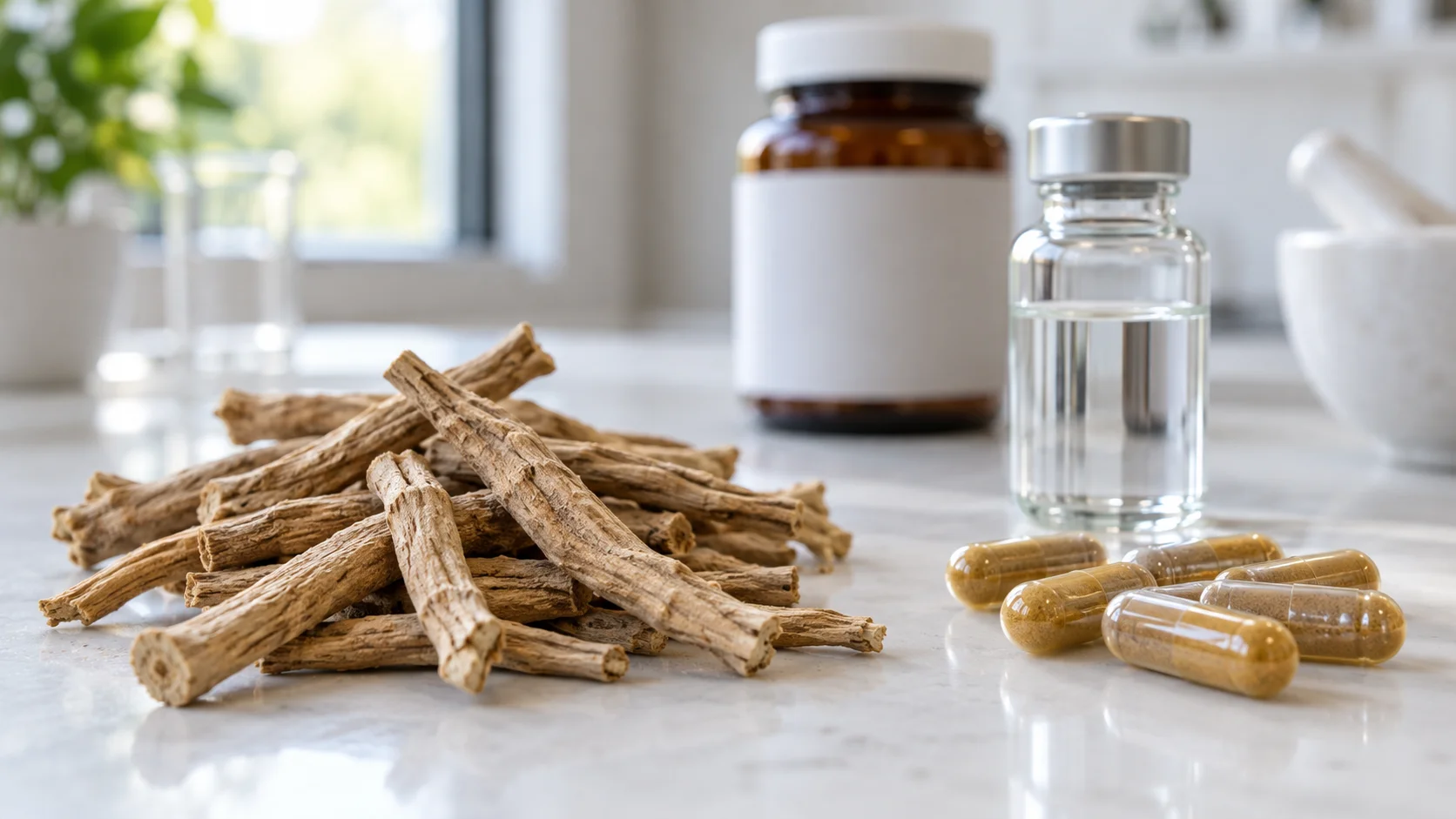
A shopper in Copenhagen cannot buy what a shopper in Albany can find in nearly any pharmacy aisle. Denmark banned ashwagandha supplements in 2023, after a 2020 risk assessment by the Technical University of Denmark examined the herb's possible effects on pregnancy and on thyroid and sex hormones. In the United States the same root sits beside magnesium and melatonin, sold in capsules, gummies and powdered lattes with promises about stress, sleep and calm.
The short answer for anyone holding a bottle is that the evidence is real and narrow at the same time. Small randomized trials, most of them run in India and most of them testing a single branded extract for six to twelve weeks, found lower stress scores and better sleep. The safety record over that window is reassuring, while the record past three months barely exists, and a short list of case reports describes liver injury and an overactive thyroid in people who took it.
This entry in The Directory walks through what the plant is, what the trials measured, where the risks sit, and how to read a label so the product in hand resembles the product that was studied.
What Ashwagandha Is
Withania somnifera is an evergreen shrub grown across tropical and subtropical Asia, Africa and Europe, and it has been part of Ayurvedic practice for centuries. Most supplements use the root. The plant is rich in steroidal lactones called withanolides, along with alkaloids, and withanolide content is the number manufacturers use to standardize their extracts.
That standardization matters more than the plant name. KSM-66, a widely sold extract, is made from root alone and was standardized to more than 5 percent withanolides in a sleep trial reviewed by the National Institutes of Health. Sensoril and Shoden are root-and-leaf extracts. A product labeled only "ashwagandha root powder, 500 mg" may hold a fraction of the withanolides in a 300 mg standardized extract, which means a dose printed on one label cannot be compared to a dose in a study without knowing which preparation it describes.
What the Stress Trials Measured
The most useful summary sits in the NIH Office of Dietary Supplements fact sheet on ashwagandha, which collects the trials in one place. A 2021 systematic review pooled 491 adults, all from India, who were randomized to ashwagandha or placebo for six to eight weeks. Across those studies, the fact sheet reports, "ashwagandha significantly reduced stress and anxiety levels" and lowered serum cortisol, the hormone that rises under strain.
The trials outside India are fewer and smaller. In a Florida study, 60 adults with a mean age of 34 who reported stress took 225 mg or 400 mg a day of a proprietary root-and-leaf extract called NooGandha, or a placebo, for 30 days. Both ashwagandha groups reported improvements in stress, and the 225 mg group had lower saliva cortisol than the placebo group.
One larger trial complicates the picture. In a 12-week study of 120 people using an extract called Witholytin, ashwagandha did not reduce perceived stress compared with placebo, though it did reduce fatigue. A result like that is a reminder that each branded extract is in effect its own product, and that a finding for KSM-66 or Shoden says little about a different preparation.
A 2022 taskforce from the World Federation of Societies of Biological Psychiatry and the Canadian Network for Mood and Anxiety Treatments provisionally recommended 300 to 600 mg a day of root extract, standardized to 5 percent withanolides, for generalized anxiety disorder. The word provisional carries weight there, since the recommendation rests on short trials with modest enrollment.
What the Sleep Trials Measured
Sleep is where the pooled data look most consistent. A 2021 systematic review and meta-analysis by Cheah and colleagues in PLOS ONE combined five studies with 372 participants and found that ashwagandha extract had a small but significant effect on sleep. The benefit was larger at 600 mg a day and when people took it for at least eight weeks, and it was more pronounced in people with insomnia than in healthy sleepers.
Individual trials fill in the detail. In a six-week study of 150 adults using Shoden, sleep quality improved in 72 percent of the ashwagandha group against 29 percent of the placebo group. In an eight-week trial of 80 adults, the participants with insomnia who took KSM-66 showed improvements in sleep quality.
Readers who reach for ashwagandha to fix sleep should know that timing and regularity often move the needle before any capsule does, a point we covered in our piece on why a consistent bedtime can matter more than total hours.
Where the Risks Sit
The NIH fact sheet states the safety picture in one line: "Ashwagandha appears to be well tolerated for up to about 3 months of use, but its long-term safety is not known." Nearly every trial in the evidence base ended inside that window, so anyone taking it for a year is outside what the research covers.
The Liver
The first published signal came from Japan in 2017, when a 20-year-old man developed liver dysfunction and high bilirubin after taking ashwagandha alongside several antianxiety drugs. Later reports described acute liver injury in other people, some of whom already had liver disease. In one series of five cases, three men and two women between 21 and 62 had taken 450 to 1,350 mg a day for one week to four months, and they developed jaundice, itching, nausea, lethargy and abdominal discomfort.
In those cases and others, people improved after they stopped the supplement, and some needed medical treatment. Investigators could not always confirm what was in the products, and some were blends with other herbs. Liver injury from concentrated botanical extracts is a recurring theme in this category, and readers can compare the pattern with our reporting on enhanced-absorption curcumin and liver safety.
The Thyroid and Hormones
Three published case reports describe thyrotoxicosis, an overactive thyroid state, in people taking ashwagandha, and symptoms resolved in all three after they stopped. The NIH notes that the herb might also interact with thyroid hormone medication. Ashwagandha use might raise testosterone, which led the fact sheet to caution that it might not be safe for men with hormone-sensitive prostate cancer.
Pregnancy and Medications
Some experts advise against ashwagandha in pregnancy because of reports suggesting it could cause miscarriage, though the American Herbal Pharmacopoeia has said its report on the subject was misrepresented. France's food safety agency, ANSES, recommended against use by pregnant and breastfeeding women and other groups. Beyond thyroid drugs, the NIH lists possible interactions with antidiabetes medications, blood pressure drugs, immunosuppressants and sedatives, a list that covers a large share of adults on daily prescriptions.
How to Read an Ashwagandha Label
A useful label answers five questions before a reader decides anything. It should name the plant part, root or root and leaf, since the trials split along that line. It should name the extract, whether KSM-66, Shoden, Sensoril or another branded preparation, because each one has its own small evidence base. It should give the withanolide percentage, with 5 percent the figure most often used in studies, and it should give the dose in milligrams of extract, which for stress trials ranged from 240 to 1,250 mg a day and for the sleep meta-analysis ranged from 250 to 600 mg.
The fifth question is how long a reader plans to take it. Matching the three-month window the research covers, and then stopping to reassess, keeps a user inside the evidence rather than outside it. Gummies and drink mixes often list an ashwagandha amount without any standardization at all, which makes them the hardest format to compare with the studies.
Signs that warrant stopping and calling a clinician are the ones from the case reports: yellowing skin or eyes, dark urine, persistent itching, nausea or abdominal pain, and a racing heart, tremor or unexplained weight loss that might point to the thyroid.
Who Should Skip It
People who are pregnant or breastfeeding, anyone with thyroid disease or a history of liver disease, and men with hormone-sensitive prostate cancer fall into the groups the NIH and ANSES flag. Anyone taking levothyroxine, insulin or other diabetes drugs, blood pressure medication, sedatives or immunosuppressants has an interaction question to settle with a prescriber before the first capsule.
For everyone else, the record supports a short, standardized trial at a studied dose, with sleep the most consistent result and stress a smaller, more uneven one. Denmark weighed the same literature and decided the uncertainty outweighed the benefit for its shoppers. American shoppers make that call one bottle at a time, and the label is where the decision starts.