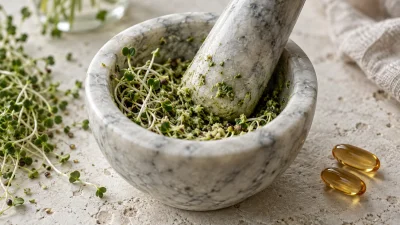
It is always a bright yellow capsule. The lighting is good, the voice is calm and certain, and somewhere in the first ten seconds you are told that this little plant compound does roughly what the injection does, minus the needle, the prescription, and the price tag. The pitch, in one version or another, has been watched well past a hundred million times. The product is usually berberine, and the internet has crowned it nature's Ozempic. It is one of the most-Googled weight ideas of the decade, and almost everything implied by that nickname is wrong.
The reason it is wrong is also the reason it matters. Nothing sold in a supplement aisle works the way a GLP-1 drug works. But your body already manufactures the hormone those drugs imitate, and a small set of ordinary foods genuinely nudges that system into action. The real opportunity was never a capsule that impersonates a medication. It is learning which inputs actually speak the language of your own satiety hormones, and then using them on purpose. That is a quieter promise than the one in the video, and it happens to be the true one.
What the drugs are actually doing
GLP-1 stands for glucagon-like peptide-1, a hormone your gut releases after a meal. It prompts the pancreas to release insulin, slows the rate at which your stomach empties, and tells your brain you have had enough. Medications like semaglutide (Ozempic, Wegovy) and tirzepatide (Mounjaro, Zepbound) are GLP-1 receptor agonists, which is a clinical way of saying they are synthetic keys cut to fit the same lock. They hold that lock open far longer and far more forcefully than any plate of food ever could, which is why trials show average losses in the range of 30 to 50 pounds compared with placebo. These are real medicines for a real disease, and for a great many people they are the correct choice. Any honest conversation about a natural alternative has to begin by admitting that, rather than pretending a shrub can substitute for a receptor agonist.
The berberine question
Berberine is not a fad invented by an algorithm. It is a yellow compound found in plants like barberry, goldenseal, and Oregon grape, and it has been used in traditional Chinese and Ayurvedic medicine for centuries. It also does real things. The trouble is the nickname. Berberine does not act on the GLP-1 receptor at all; it works mostly through an enzyme often described as the body's energy switch, influencing insulin sensitivity and blood sugar rather than appetite hormones. Calling it nature's Ozempic is not a description. It is positioning.
The evidence reflects that gap. UCLA Health dietitians note that any weight effect tends to appear only after at least eight weeks of daily use, and that the amount you might lose is unclear and the research inconclusive. Reviews that try to pin down a number land on something modest, on the order of 2 to 5 percent of body weight over eight to twelve weeks, almost always alongside diet changes. One obesity specialist put the typical effect at a fraction of a single BMI point, nowhere near what semaglutide produces, even as videos tagging the compound piled up past 127 million views. It is also not consequence-free. Physicians have flagged that rigorous data are thin and that berberine can interact with medications processed by the liver, which matters more than the marketing ever mentions.
None of this makes berberine worthless. It has a defensible case as a metabolic-support supplement, particularly for people whose blood sugar runs high. But that is a smaller, more specific claim than the one stamped on the bottle, and the smartest first move with any of these products is to know what is actually inside one. Reading a label with a skeptic's eye is its own skill, and our breakdown of the synthetic fillers and substitutions hiding in mainstream supplements is a useful companion before you spend a dollar on yellow capsules.
What genuinely speaks to the system
If a supplement cannot mimic the drug, what can move your own satiety machinery? The answer is less photogenic than a capsule and considerably better supported. It starts with soluble fiber. When viscous fiber reaches your colon, resident bacteria ferment it into short-chain fatty acids, chiefly acetate, propionate, and butyrate. Those compounds are not just fuel for your gut lining; they act as signals, latching onto receptors on the intestinal L-cells that prompt those cells to release GLP-1. Fiber also thickens the contents of the stomach and slows digestion, which is the mechanical half of feeling full. This is not folklore. It is the same fermentation-and-signaling pathway documented in the clinical literature, the body's own version of the lever the drugs pull. Aiming for roughly 25 to 35 grams of fiber a day from a range of plants is the most evidence-backed thing in this entire conversation.
Protein is the second lever, and it pulls in two directions at once. Amino acids from a protein-rich meal trigger their own nutrient sensors on the same L-cells, stimulating the release of GLP-1 and a sister hormone, PYY, both of which quiet appetite. Protein also costs the body more energy to digest than carbohydrate or fat, and, crucially, it defends lean muscle, the metabolically active tissue that keeps your resting burn rate from sliding. Fat plays a supporting role rather than a starring one. It does not summon GLP-1 as sharply as protein does, but the omega-3 fats in fatty fish, walnuts, and flaxseed appear to steady L-cell function and tamp down the inflammation that can blunt the whole signal. Even a modest square of dark chocolate brings flavanols that may nudge GLP-1 activity, a small pleasure with a footnote of science attached.
Notice what these inputs have in common. None of them is exotic, none requires a subscription, and all of them support broader metabolic health and a healthier gut microbiome as a side effect rather than a side effect risk. The "natural" version of this story is not a pill that pretends to be a drug. It is a plate built to provoke the hormones you already own.
The real story of 2026: the off-ramp
There is a reason this conversation has gotten louder, and it has almost nothing to do with influencers. Roughly one in eight American adults has used a GLP-1 medication, and a striking share of them do not stay on it. Real-world data suggest that up to 65 percent of users discontinue within a year, often because of cost, insurance, or side effects. What happens next is where the natural-support question stops being a gimmick and becomes genuinely important.
When the medication stops, the appetite it was suppressing comes back, and so does the weight. A 2026 review in the BMJ found that people coming off these drugs regain close to a pound a month, often returning to their starting weight within two years. A separate meta-analysis published this year modeled the curve more precisely, estimating that about 60 percent of lost weight returns within twelve months before the weight regain tends to plateau. This is not a failure of willpower. It is biology reasserting a set point, which is exactly why clinicians now describe obesity as a chronic, relapsing condition rather than a project with an end date.
The off-ramp also carries a quieter risk: muscle. Rapid weight loss strips away lean tissue along with fat, and specialists are urging people on and after these drugs to protect it by eating a high-protein diet, on the order of 80 to 120 grams of protein a day, paired with resistance training. This is the moment where fiber and protein stop being a wellness suggestion and start functioning as a maintenance strategy, the closest thing we have to keeping the dimmer switch on after the medication is gone.
How to actually build it
Dietitians have a tidy name for the practical version of all this: satiety stacking, the habit of building each meal around the combination of protein, fiber, and healthy fat rather than any one of them alone. The first meal of the day is the highest-leverage place to start; clinicians coaching people through GLP-1 transitions often suggest front-loading it with at least 25 grams of protein and 15 grams of fiber to blunt the cravings that build over a long morning. Eating on a steady schedule matters as much as the contents of the plate, because long gaps tend to manufacture the kind of chaotic hunger that wrecks good intentions.
If you still want to try berberine after all that, the responsible path is narrow but clear: choose a third-party-tested product, start with a conservative dose, and, because of those liver-enzyme interactions, walk your full medication list past a pharmacist or physician first. Treat it as a possible small assist to a metabolic plan, never as a replacement for one. The same discipline applies to the rest of your cabinet, and the broader case for leaning on daily habits that quietly reduce your reliance on over-the-counter fixes is worth reading alongside this one.
Two more pillars deserve a place in the plan. The first is muscle, which means movement, and not only the gym variety; the performance and recovery side of building durable strength is covered in depth by our partners at H2Goals, whose lane is exactly the protein-and-output equation this story keeps circling. The second is attention. The drugs are praised for silencing what users call food noise, the low hum of intrusive thoughts about eating, and rebuilding that quiet without a prescription leans on slower skills like mindful eating and a steadier nervous system, the territory our friends at KitsnCo explore through movement and breath.
The honest reframe
The phrase nature's Ozempic was always a category error. It took a genuine medical breakthrough, flattened it into a vibe, and sold the vibe back to people in a yellow capsule. The truer and far more durable idea is hiding underneath the hype: you are not trying to find a natural copy of a drug. You are trying to feed and move your body in the ways that make its own hormones do their job. Fiber, protein, steadiness, and patience will never trend the way a miracle pill does. They will, however, still be working long after the video has scrolled out of view.