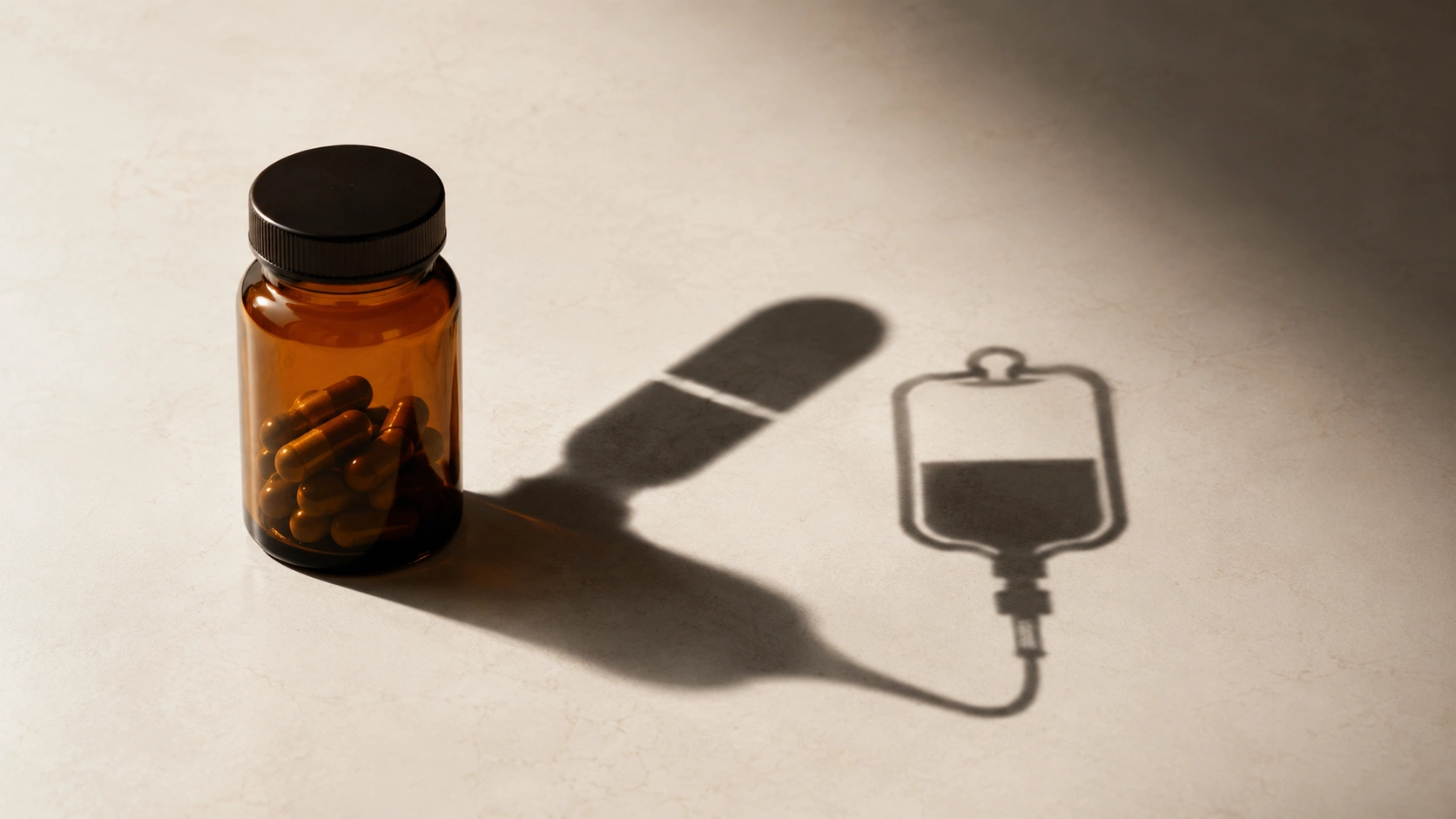
There is a small amber bottle that sits on health-store shelves somewhere between the magnesium and the milk thistle. There is an identical molecule hanging in a bag in nearly every emergency room in the country, where it is used to pull people back from the edge of liver failure. They are the same compound. The shelf calls it a supplement. The hospital calls it a drug. For the better part of five years, the United States government could not decide which label was correct, and the argument it had with itself reveals more about how we draw the line between medicine and wellness than almost any other ingredient on the market.
The compound is N-acetylcysteine, NAC for short, and it deserves to be understood on its own terms before anyone gets to the politics. It is one of the rare supplements whose biology is genuinely well documented, whose oldest uses rest on decades of hard clinical evidence, and whose newest uses sit squarely in the promising-but-unproven frontier where enthusiasm tends to outrun the data. Telling those three categories apart is the entire skill.
What the molecule actually is
NAC is an acetylated form of cysteine, one of the amino acids your body uses to build proteins. Its single most important job is to act as raw material for glutathione, the compound frequently described as the body's master antioxidant. Glutathione is what your cells lean on to neutralize damaging molecules, and the supply of cysteine is usually the rate-limiting step in making more of it. Give the body NAC and you hand it the missing ingredient, which is why supplementing it reliably raises the body's own glutathione production.
That one mechanism radiates outward. By replenishing glutathione and mopping up free radicals directly, NAC works as both a direct and indirect antioxidant, which is why it keeps reappearing in conditions driven by oxidative stress. It also carries anti-inflammatory effects, dialing down signals like NF-kB and TNF-alpha, and it can cross into the brain, where it nudges the glutamate system. A surprising amount of the NAC research library is really just this single antioxidant story, retold in one organ after another.
The medicine it has always been
Strip away the supplement framing and NAC is a workhorse drug that has been FDA-approved since 1963. Its most dramatic role is as the antidote to acetaminophen overdose. When someone takes too much acetaminophen, the active ingredient in Tylenol, the liver throws off a toxic byproduct called NAPQI that burns through the organ's glutathione and starts destroying tissue. NAC reverses the crisis by restoring glutathione and detoxifying that metabolite, which is why it is stocked in emergency departments and counted among the genuinely life-saving tools in medicine. That is not a wellness claim. It is a hospital protocol, and it is the single strongest piece of evidence NAC owns.
Its second established job is as a mucolytic, a mucus-thinner. The thiol groups in NAC break the disulfide bonds that hold thick mucus together, loosening it in conditions like chronic bronchitis, COPD, and cystic fibrosis. It was in fact first developed as a mucolytic in the 1960s, with the antidote use discovered later. Both of these are drug uses: prescribed, measured, and dosed as medicine. It is worth holding onto that fact as we walk toward the supplement aisle.
The frontier, where the evidence thins
Then there is everything else, and here the honest answer gets more interesting. Because NAC touches glutathione, inflammation, and brain chemistry all at once, researchers have aimed it at a sprawling list of conditions: obsessive-compulsive disorder and the related hair-pulling and skin-picking behaviors, substance cravings, respiratory health beyond simple mucus, male infertility, and polycystic ovary syndrome, among others spanning mental health and fertility. The logic behind the psychiatric interest is real. NAC appears to help rebalance the brain's glutamate system, which is disrupted in addiction, and some studies suggest it can blunt craving and compulsion.
But a plausible mechanism is not the same thing as a proven benefit. Across most of these frontier uses, the clinical trial results remain limited and often conflicting, which is the careful scientific way of saying we do not yet know. This is exactly the territory where supplement marketing loves to plant a flag, and exactly where a sharp reader should keep one eyebrow raised. The gap between "studied for" and "shown to work" is where most of the hype lives.
The fight over a definition
Which brings us to the strange legal saga. NAC had been sold quietly as a dietary supplement for decades when, in 2020 and 2021, the FDA began sending warning letters to companies marketing it, many of them for hangover cures, asserting that NAC could not lawfully be a supplement at all. The reasoning was a technicality buried in the statute: because NAC had been approved as a drug back in 1963, years before the 1994 law that governs supplements, a clause appeared to exclude it from the supplement definition entirely. In May 2021, Amazon began pulling NAC products from its store, and an ingredient millions of people had used for years suddenly looked like it might disappear.
The industry fought back with lawsuits and formal petitions, arguing that the products had been on shelves since the early 1990s and that the exclusion was never meant to apply retroactively. In August 2022 the agency blinked, in a fashion. It issued final guidance announcing it would exercise enforcement discretion, meaning it still officially considered NAC excluded but would not act to stop companies from selling it. That uneasy truce is the status quo today. You can buy NAC freely, but it sits on a kind of regulatory probation. The FDA has since signaled it may finally settle the matter with a first-of-its-kind rule formally declaring the ingredient not excluded, but that rule was targeted for early 2026 and had not been published as of late 2025, leaving NAC precisely where it has lived for years: legal, popular, and technically in limbo. The agency's slow grind over ingredient policy is a recurring pattern, not unlike its phase-out of petroleum-based synthetic food dyes set in motion over the same stretch.
How to actually think about it
So what should a thoughtful person do with all of this? Start by dropping the crunchy framing. NAC is not a foraged root or a gentle botanical. It is a synthesized molecule that happens to be sold in both the pharmacy and the supplement aisle, and that dual citizenship is what makes it interesting rather than a strike against it. The case for taking it as a daily supplement rests mostly on the antioxidant and glutathione-support rationale, the general cellular-maintenance lane rather than the treat-a-disease claims that supplement law forbids in the first place. If recovery and antioxidant capacity are genuinely what you are chasing, that is the same ground our colleagues at H2Goals cover from the performance and hydration side.
Two cautions matter more than the marketing will tell you. The first is quality. Because NAC is sold in a gray zone, brand reputation and third-party testing carry more weight than usual, and scrutinizing what is actually in the bottle is a habit worth building, the same discipline we walk through in our look at the synthetic fillers hiding in mainstream supplements. The second is that NAC is not for everyone. It can interact with certain medications and warrants caution in people with asthma or a history of gastrointestinal ulcers, so a conversation with a clinician belongs at the front of the process, not as an afterthought. And the antidote use, to be unambiguous, is an emergency hospital treatment and never a do-it-yourself project.
The line that was never a wall
The deeper lesson of NAC is that the barrier we imagine between medicine and supplement is not a wall at all. It is a negotiated line, drawn by statute and redrawn by lawyers, and the same molecule can stand on either side of it depending on the label, the dose, and the decade. NAC is the compound that makes that visible. Its best-proven uses are pure medicine, its trendiest uses are pure speculation, and most of its real value for an already healthy person lives in the quiet middle, as a well-understood building block for the body's own defenses. It is worth respecting on all three counts, and worth genuinely understanding before it ever lands in your cabinet.