If you've been paying attention to food and wellness news in the past year, you've probably caught a headline or two about food dyes. But most of the coverage has focused on the politics and the brand names, which cereals are affected, which politicians made the announcement, which companies are dragging their feet. What's gotten far less attention is the underlying science that drove this shift, and what it actually means for the way you and your family eat every day.
The short version: the FDA has announced plans to eliminate all petroleum-based synthetic food dyes from the U.S. food supply by the end of 2026. That includes Red 40, Yellow 5, Yellow 6, Blue 1, Blue 2, and Green 3, the six most widely used artificial colorants in American food products. Two additional dyes, Citrus Red 2 and Orange B, are being revoked on an even faster timeline. Red 3, which was formally banned in January 2025, is being pushed out ahead of its original 2027 deadline as well.
This is not a minor regulatory adjustment. It is the most significant shift in U.S. food additive policy in decades, and understanding why it's happening, and what comes next, is worth your full attention.
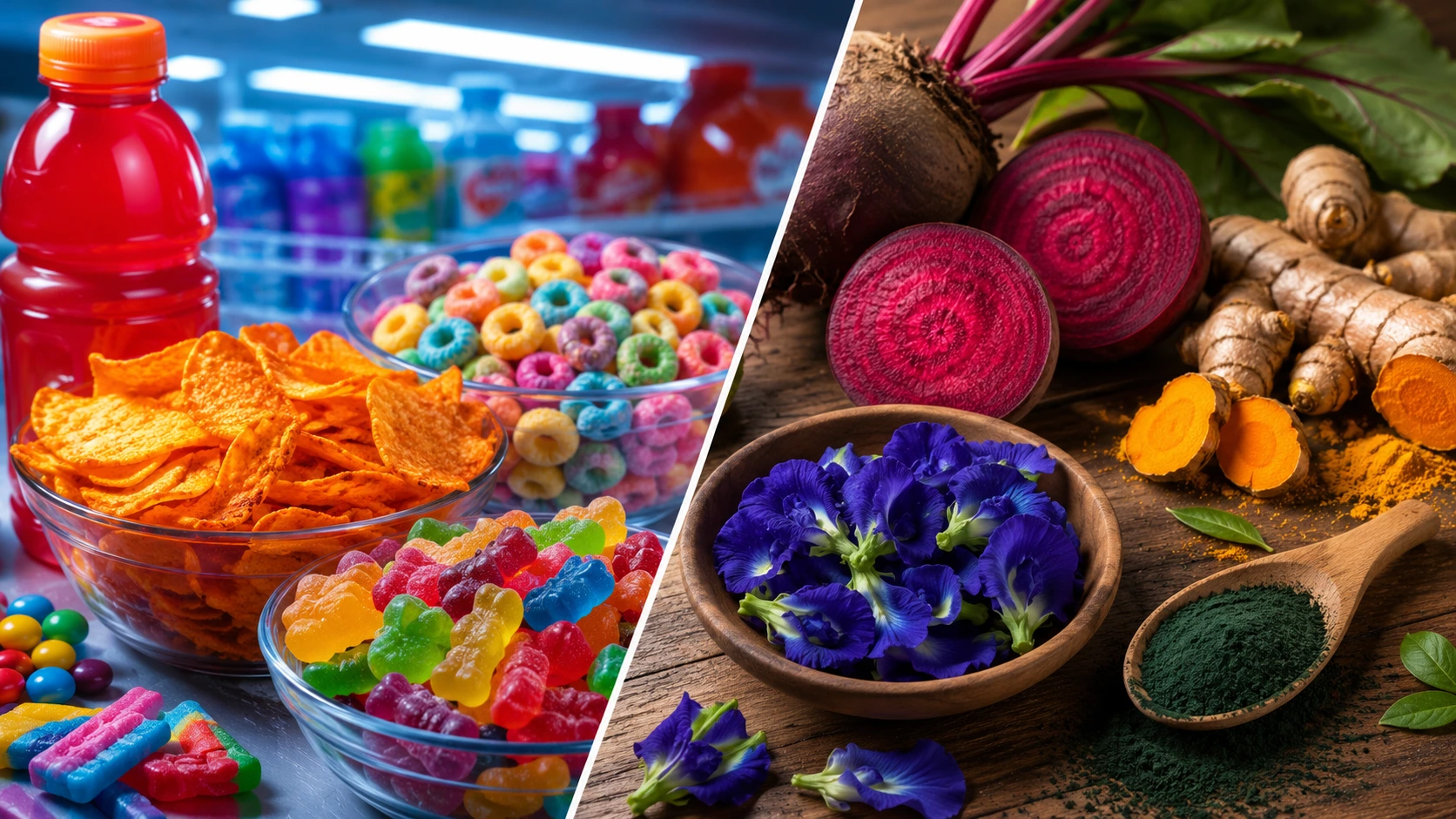
The name tells you most of what you need to know. Petroleum-based synthetic dyes are exactly what they sound like: color additives derived from crude oil through industrial chemical processes. They were introduced into the American food supply in the early twentieth century as inexpensive, highly stable alternatives to the natural colorants that had been used in food preparation for centuries. By the mid-twentieth century, they were everywhere. They are still everywhere: in breakfast cereals, sports drinks, candy, baked goods, flavored chips, fruit snacks, salad dressings, medications, and vitamins.
Their appeal to food manufacturers is straightforward. They are dramatically cheaper than natural alternatives, they produce vivid, consistent colors that don't fade under heat or light exposure, and they have an almost indefinite shelf life. From a manufacturing standpoint, they solve a lot of problems. From a health standpoint, the picture has grown considerably more complicated over the past two decades. And as we've covered in our breakdown of synthetic ingredients in everyday supplements, artificial dyes are far from the only petroleum-derived compounds that have found their way into products Americans consume daily.
The health concerns surrounding synthetic food dyes are not new, and they are not fringe. In 2021, the California Office of Environmental Health Hazard Assessment completed a comprehensive, systematic review of the evidence, including 27 human clinical trials plus animal and in vitro research. Its conclusion was pointed: the seven most widely used synthetic food dyes, including Red 40, Yellow 5, Yellow 6, Blue 1, and Blue 2, can cause or exacerbate neurobehavioral problems in some children, including hyperactivity, inattentiveness, and restlessness.
This finding built on a body of research that had been accumulating for decades. A landmark 2007 study published in The Lancet, one of the most respected medical journals in the world, found that mixtures of artificial food colors combined with the preservative sodium benzoate produced measurable increases in hyperactive behavior in children. That study was significant enough that the European Union responded by requiring warning labels on foods containing certain synthetic dyes stating that the product "may have an adverse effect on activity and attention in children." That requirement has been in place in Europe since 2010. The United States, until very recently, had taken no equivalent action.
FDA Commissioner Martin Makary, announcing the phase-out plan, cited research linking petroleum-based dyes to ADHD, obesity, diabetes, insulin resistance, and cancer. Red Dye 40, specifically, has been studied for its benzene content, a compound with established links to cancer risk. The science does not support the conclusion that synthetic dyes are the sole or even primary driver of any of these conditions. But the accumulating evidence that they contribute meaningful risk, particularly for children who are exposed to them across multiple products every single day, has become difficult to responsibly ignore.
Here is where it gets more complicated, and where informed consumers need to read carefully. The FDA's plan, as announced, is not a formal ban enforced by law. It is a voluntary industry agreement, asking food manufacturers to comply with the phase-out timeline on their own initiative. The Center for Science in the Public Interest noted that because using synthetic dyes has always been voluntary, the announcement creates no new legal obligation for companies that choose not to comply.
Consumer Reports raised similar concerns, pointing out that the plan is "short on details" about what action the FDA would take if companies fail to remove the dyes by the stated deadline. Staff and budget cuts at HHS and the FDA have prompted additional questions about enforcement capacity. Some advocacy groups believe full transition could take years beyond 2026 to achieve in practice, and are urging states to continue adopting their own legislative bans in the meantime.
That said, the industry response has been substantive. General Mills has committed to eliminating certified color additives from all U.S. cereals by summer 2026. Kraft Heinz has pledged full removal of synthetic dyes from its U.S. portfolio by the end of 2027. The J.M. Smucker Company began reformulating Hostess snack cakes and fruit pies in early 2025, replacing synthetic reds and yellows with beet juice and paprika extract. PepsiCo CEO Ramon Laguarta confirmed on a Q1 earnings call that brands including Lay's and Tostitos will remove artificial colors by year's end. The International Dairy Foods Association announced a voluntary pledge to eliminate certified artificial colors from dairy products sold to K-12 school programs beginning with the 2026-27 school year.
The market momentum is real, even if the regulatory teeth remain limited.
The shift toward natural food colorants has been accelerating in parallel with the regulatory pressure. The FDA has approved or expanded the approved uses of several natural dye alternatives in recent months, including beetroot red, spirulina extract for blue and green shades, butterfly pea flower extract, Galdieria extract blue, calcium phosphate, and gardenia blue. These join a group of plant-derived colorants that have been in use in natural and organic products for years.
The natural alternatives color palette maps onto the synthetic one fairly directly. Beet juice and hibiscus deliver reds and pinks. Turmeric produces yellow and gold tones. Spirulina provides blue-green shades. Paprika and annatto cover orange. Matcha and spinach extract deliver greens. Butterfly pea flower, one of the more novel recent approvals, produces a striking blue that shifts to purple when exposed to acids, making it particularly useful in beverages.
The transition is not without complications. Natural colorants are more expensive to source and process, less stable under heat and light, and more variable in hue consistency than their synthetic counterparts. Matching the specific vivid red of a synthetic dye with beet juice requires significant reformulation work. Industry sources estimate that it takes roughly a quarter to a half of a medium beet to color a single bottle of sports drink, and scaling that across millions of units creates real agricultural and supply chain challenges.
Experts also note that the word "natural" does not automatically confer safety or nutritional value. Most natural colorants used in processed foods are present in amounts too small to deliver meaningful nutritional benefit. The goal is not to make junk food healthy by changing its color source. The goal, as one nutrition researcher put it plainly, is to "limit ultra-processed foods and eat more whole foods" where color comes as nature packaged it.
The phase-out timeline means that many products you currently buy will be reformulated over the next 12 to 24 months. Some already have been. Reading labels is more important now than it was a year ago, because the products on shelves today may not reflect what those same products will look like by the end of the year.
The ingredient list is your most reliable guide. Synthetic dye names are always listed explicitly: "Red 40," "Yellow 5," "Yellow 6," "Blue 1," "Blue 2," and "Green 3." If those names appear, the product has not yet been reformulated. Natural alternatives will be listed as their source ingredient: beet juice, turmeric, spirulina extract, annatto, paprika extract, or similar.
For families with children who show sensitivity to food additives, this transition carries particular significance. The neurobehavioral research is not conclusive for all children, and synthetic dyes do not affect every child the same way. But the precautionary argument for reducing exposure while the science continues to develop is straightforward: these dyes provide no nutritional benefit whatsoever. Their only function is aesthetic. Given that, the risk-benefit calculation for reducing consumption is not a difficult one. Parents navigating these ingredient questions in the context of their children's overall nutrition will find additional context at Family Symposium, which covers food policy and family wellness from a parent-centered lens.
The FDA's announcement is, at its core, a regulatory validation of what the natural wellness community has been saying for years. The ingredients in your food matter beyond what the marketing on the front of the package suggests. The label on the back, read carefully, is where the real story lives. That principle does not change when the dye source changes. It only becomes more relevant as the transition unfolds and new formulations reach shelves with marketing that may not yet reflect the scrutiny they deserve.
Knowing how to read what you're actually buying has never been more important than it is right now.